
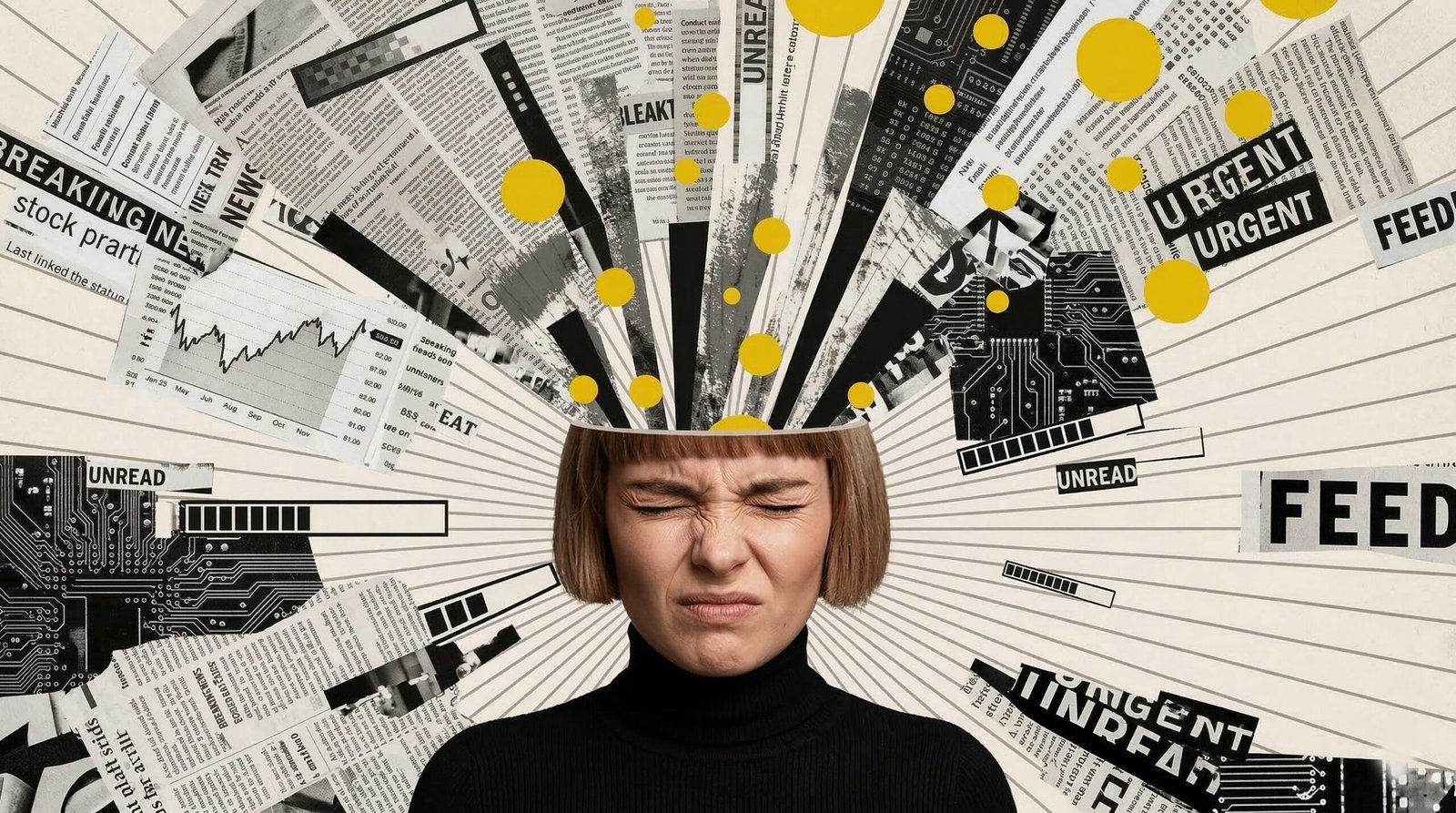
Many people are beginning to notice something strange.
Why too much information is making you more confused instead of clearer.
We live in the most informed age in human history.
Yet clarity about how to live seems harder than ever.
The Paradox of the Information Age
Everything is just a click of a button away these days.
Why too much information is making you more confused is one of the quiet paradoxes of modern life.
You have access to more knowledge than any human generation before you.
Unlimited books.
Endless articles.
Infinite videos.
Expert opinions on everything.
Every philosophy.
Every diet.
Every spiritual teaching.
Every lifestyle approach.
All available instantly.
This should ideally create clarity.
More information → better understanding → clearer decisions.
But that is not what most people experience.
Instead, many people feel:
More confused.
More uncertain.
More anxious about making the wrong decision.
Because when every new idea contradicts the last, the mind struggles to settle.
This growing sense of chaos in modern life is explored further in How to Remain Sane in an Insane World.
How Certainty Once Worked
For most of human history, people lived inside inherited systems.
Religion explained meaning.
Culture defined behavior.
Tradition defined roles.
Community reinforced values.
Most people rarely questioned these structures.
They simply lived within them.
The mind rested in certainty.
Not necessarily because those beliefs were true.
But because they were stable.
Because the human mind prefers certainty.
Even false certainty can feel safer than unanswered questions.
These systems also quietly reduced the mental burden of constantly deciding how life should be lived.
What to eat.
How to behave.
How to raise children.
What is right or wrong.
Much of this stability came from inherited identity structures, something explored in Identity Is the Hidden Problem Generator.
Then Everything Started Being Questioned
The internet changed the landscape completely.
Every belief could now be challenged.
Every idea could now be debated.
Every tradition could now be questioned.
At first, this felt liberating.
People celebrated the freedom to think independently.
New concepts, new perspectives.
But something unexpected followed.
For every belief that collapsed, dozens of new alternatives appeared.
Each sounded convincing.
Each is supported by arguments and examples.
Clarity did not increase.
Confusion multiplied.
The mind that once relied on one stable framework was now exposed to hundreds.
And switching between them created what many people now experience as a kind of belief whiplash.
One idea feels right in the moment.
Until the next one replaces it.
Now AI Is Accelerating the Flood
Just when people were beginning to adjust to the internet,
another shift appeared.
Artificial intelligence.
AI can now answer questions instantly.
Summarize books.
Explain complex ideas.
Generate opinions.
All within seconds.
At first, this feels powerful.
Knowledge appears unlimited.
Understanding seems immediate.
But something subtle happens again.
AI does not remove contradictions.
It often multiplies them.
Ask the same question in different ways,
and you may receive different explanations.
Each sounding logical.
Each sounding convincing.
The mind receives even more viewpoints.
More interpretations.
More perspectives.
Instead of reducing confusion,
AI can sometimes accelerate it.
Not because technology is harmful,
but because information alone does not create clarity.
This shift between human intelligence and awareness is explored further in When AI Outthinks Us: The Shift from Human Intelligence to Human Awareness.
The Monday-to-Friday Philosophy Shift
A reel about minimalism appears.
Owning less promises peace.
It makes sense.
You feel convinced.
Then another post appears about wealth creation.
Financial freedom promises security.
It also makes sense.
Soon, a spiritual teacher says material success is meaningless.
That also feels true.
Then an entrepreneur argues money creates freedom.
Again convincing.
Within a few days, you encounter multiple philosophies about how life should be lived.
Each persuasive.
Each contradictory.
The mind swings between them.
One philosophy replaces another.
Then another replaces that.
This is what many people experience today as belief whiplash.
When the mind keeps jumping between opposing viewpoints, reactions become automatic rather than conscious, something explored in Respond Consciously Instead of Reacting Automatically.
Information overload is not just giving people more knowledge.
It is quietly disturbing the systems the human mind once depended on for stability.
When the Mind Loses Its Ground
For generations, people lived inside inherited frameworks.
Religion explained existence.
Culture defined behavior.
Society shaped roles.
Tradition guided decisions.
The mind settled inside these structures comfortably.
It repeated the same beliefs.
It defended the same ideas.
It rarely questioned them.
In many ways, the mind prefers this state. In certainty
A stable story about how life works.
A familiar pattern that does not need to be examined constantly.
But the modern information environment has started shaking those foundations.
Suddenly everything is being questioned.
Lifestyle choices.
Religion.
Politics.
Food and health.
Relationships.
Even personal identity.
For every belief someone once held,
dozens of alternative viewpoints now appear.
A reel explains one way to live.
Another post argues the opposite.
A podcast promotes one philosophy.
A video dismantles it.
Each explanation sounds convincing at the moment.
But because the perspectives are endless,
the mind struggles to settle anywhere.
The old certainties begin to weaken.
But the new ideas are too many to commit to.
So the mind remains in between. In the air. Floating.
Searching.
Comparing.
Reconsidering.
Trying to find somewhere stable to stand in certainty
The Airplane That Cannot Land
Imagine your mind like an airplane.
Old inherited beliefs were the runway.
When you began questioning them, the plane took off.
At first, the freedom felt exciting.
You were no longer trapped by tradition.
But then something strange happened.
You looked down and saw thousands of runways.
Minimalism runway.
Wealth runway.
Spiritual runway.
Scientific runway.
Entrepreneurial runway.
Each claiming to be the right place to land.
The plane keeps circling.
Consuming more information.
Searching for the correct runway.
But clarity does not appear.
The mind simply wants somewhere to land.
Somewhere certain.
Why the Mind Struggles With Endless Options
When the mind faces too many choices, something predictable happens.
Choosing becomes harder.
Not easier.
Because every choice means rejecting many others.
Doubt appears.
What if another option was better?
What if you chose incorrectly?
This creates decision paralysis.
Not from lack of information.
But from too much conflicting information.
When Exhaustion Creates Certainty
Faced with endless contradictions, the mind eventually becomes exhausted. And remember, it is out of its comfort zone of being certain.
At that point, it often grabs one belief system strongly.
Not necessarily because it is correct.
But because certainty feels better than confusion.
This is why strong ideologies and rigid viewpoints often grow in the information age.
The mind simply wants the airplane to land. Land to a certainty.
Seeing this mechanism clearly is the beginning of freedom, explored further in See the Mind Clearly Before You Trust It.
Information Is Not the Same as Wisdom
Information tells you what others believe.
Wisdom comes from seeing clearly for yourself.
You can consume thousands of opinions.
Yet still do not understand your own mind.
Because clarity does not come from collecting ideas.
It comes from observing experience directly.
This shift from external answers to direct awareness is central to the 12-Step Journey to Awareness.
The Difference Between Believing and Observing
Most people live through borrowed beliefs.
Some say a diet works.
Some say a philosophy works.
Some say a spiritual practice works.
The belief is often adopted.
But observation asks a different question.
What actually happens in your direct experience?
Does this create clarity or confusion?
Does this reduce suffering or increase it?
This approach is explored further in Clarity First, Practice Later.
Where the Mind Finally Finds Ground
Clarity does not appear by choosing the perfect belief system.
It appears when the mind begins observing itself.
Reactions become visible.
Thought patterns become visible.
Conditioning becomes visible.
When observation deepens, confusion settles.
Not because life suddenly becomes simple.
But because you stop searching for fixed answers in borrowed beliefs.
Take-Home Clarity
More information does not guarantee more understanding.
When every perspective contradicts another, the mind can become overwhelmed.
Clarity begins when observation replaces constant belief-shopping.
The mind settles not when it finds the perfect philosophy.
It settles when it learns to see clearly.
FAQs
Why does too much information make people confused?
When people encounter many conflicting perspectives, the mind struggles to decide which one is correct. Instead of creating clarity, excessive information can create doubt and mental overload.
What is information overload?
Information overload happens when the brain receives more input than it can meaningfully process, making decisions harder instead of easier.
Why were people in the past more certain about life?
Earlier generations relied on inherited belief systems from religion, culture, and tradition. These systems created stability, even if they were rarely questioned.
Does questioning beliefs create confusion?
Initially it can. When old beliefs collapse and new ones appear, the mind may struggle until it learns to observe instead of constantly replacing one belief with another.
Is the solution to avoid information completely?
No. Information can be useful, but it should not replace direct observation of your own experience.
Why do people become more dogmatic in the information age?
When overwhelmed by too many options, the mind often clings to one belief system simply to regain psychological certainty.
What creates real clarity?
Clarity develops when you observe how the mind works rather than relying entirely on borrowed beliefs from others.
How can I reduce confusion in everyday life?
Limit unnecessary information, observe your reactions carefully, and test ideas through direct experience rather than immediately believing them.