

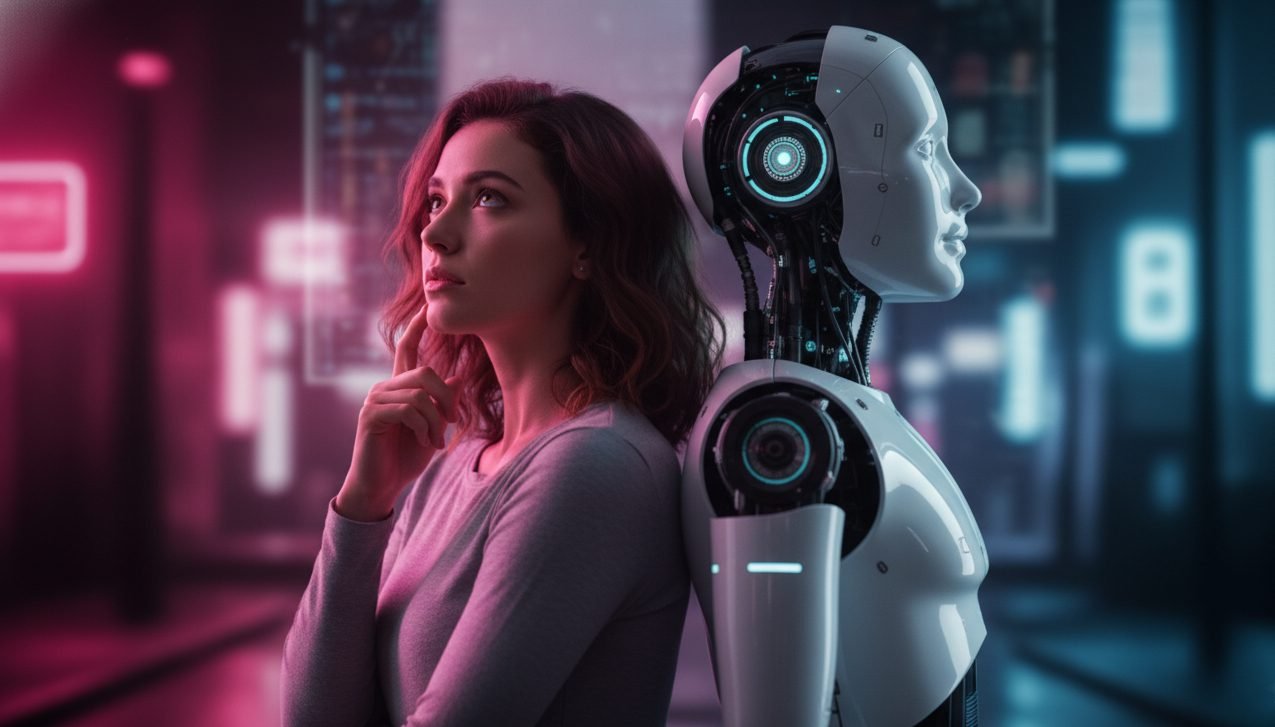
AI and human awareness are now at the center of one of the most important shifts of our time.
Artificial Intelligence is no longer a future idea.
It is here.
From research labs at IIT and Stanford to companies like IBM, Google, and OpenAI, AI is advancing rapidly. It writes, designs, diagnoses, predicts, composes music, and may soon outperform humans in many cognitive tasks.
The question many people quietly carry is this:
Is this good for humanity?
Or are we building something that will replace us?
Before reacting, we need clarity.
Intelligence Is Not the Problem
Any intelligence is good — if it is intelligence.
For centuries, humanity struggled not only because of malice, but because of ignorance. Better intelligence has always meant better medicine, better engineering, better communication and better living conditions.
If the tools around you become more intelligent, that is not a curse. It is a blessing.
The discomfort begins only when intelligence threatens identity.
The Real Fear Behind AI
The anxiety around AI is not about machines.
It is about status.
If machines can think faster, calculate better, and analyze deeper — what is left for human beings?
For centuries, we valued ourselves for:
- Thinking
- Reasoning
- Strategy
- Analysis
- Memory
But what if thought itself is computation?
Data in. Processing. Output.
If that is true, machines will eventually do it better, since that is exactly what they do.
This does not make humans irrelevant.
It exposes what we built our identity on.
Thought Is Not Consciousness
AI can compute.
It can simulate conversation. It can generate emotional language. It can analyze vast datasets in seconds.
But computation is not consciousness.
A machine can simulate empathy.
It does not experience it.
A machine can describe love.
It does not feel it.
Intelligence processes.
Consciousness experiences.
This distinction is essential when we speak about AI and human awareness.
The Identity Crisis of the AI Era
Only someone who wants to be the smartest person around feels threatened when everything else becomes smarter.
If intelligence becomes abundant, insecurity becomes visible.
This is not a technological crisis.
It is a psychological one.
As explored in Break the Story You Keep Telling Yourself, identity built on superiority is fragile.
AI destabilizes that structure.
Discomfort may not mean danger.
It may mean growth.
The Collapse of what we called Excellence
For centuries, we defined human excellence in very specific ways:
- Intelligence
- Memory
- Analysis
- Calculation
- Strategy
- Productivity
- Academic performance
We built titles around it.
Doctor. Engineer. CEO. Analyst. Researcher. Strategist. Businessman
Society rewarded speed of thought, depth of reasoning, and the ability to process information better than other qualities. Success was defined around these factors.
We equated thinking well with being valuable.
But the AI era quietly challenges this foundation.
If a machine can analyze faster than you…
Write better than you…
Diagnose more accurately than you…
Predict markets better than you…
Then what exactly was “human excellence”?
Was it intelligence?
Or was it just being the fastest calculator in the room?
For the first time in history, human thought is no longer the highest form of processing available.
That realization can feel destabilizing.
Because many identities are built on it.
Careers.
Self-worth.
Social status.
Educational prestige.
We rarely asked a different question:
Is a human being successful because of what they produce?
Or because of how consciously they live?
Society rarely measured:
- Emotional balance
- Depth of perception
- Presence
- Integrity
- Awareness
A person could be anxious, restless, disconnected — yet be called successful because of a title.
Meanwhile, someone deeply stable and aware, but without prestige, would be considered ordinary.
The AI era may quietly correct this distortion.
If machines outperform humans in cognitive tasks, intelligence alone can no longer define excellence.
We may be forced to rediscover what cannot be automated:
- Conscious experience
- Inner clarity
- Responsible action
- Deep human connection
- Self-awareness
Perhaps AI does not reduce humanity.
Perhaps it reveals what humanity actually is — beyond computation.
And that shift may be uncomfortable.
But it may also be necessary.
Closing Insight
If machines can outthink us, perhaps thinking was never the highest human ability.
Perhaps awareness is.
The AI era may not diminish humanity.
It may reveal what being human truly means.
Frequently Asked Questions
Is AI a threat to humanity?
AI itself is not inherently dangerous. The real risk lies in how humans use intelligent systems. Without awareness and responsibility, powerful tools can amplify unconscious behavior.
Can AI replace human intelligence?
AI can outperform humans in many computational and analytical tasks. However, human awareness, lived experience, and conscious presence remain fundamentally different from machine processing.
What is the difference between intelligence and consciousness?
Intelligence processes information and generates responses. Consciousness involves awareness of experience — the ability to observe thought, feel emotion, and act with clarity.
Will AI take away human jobs?
AI is likely to automate many cognitive roles. This shift may redefine how we measure value, moving beyond intellectual performance toward qualities like creativity, emotional depth, and ethical responsibility.
Why do people feel insecure about AI?
For centuries, identity was built around being intellectually superior. When machines begin to outperform human thinking, that identity feels unstable — and insecurity surfaces.
Can AI ever become conscious?
Current AI systems simulate intelligence but do not possess subjective awareness or lived experience. Consciousness involves direct experience, which machines do not demonstrate.