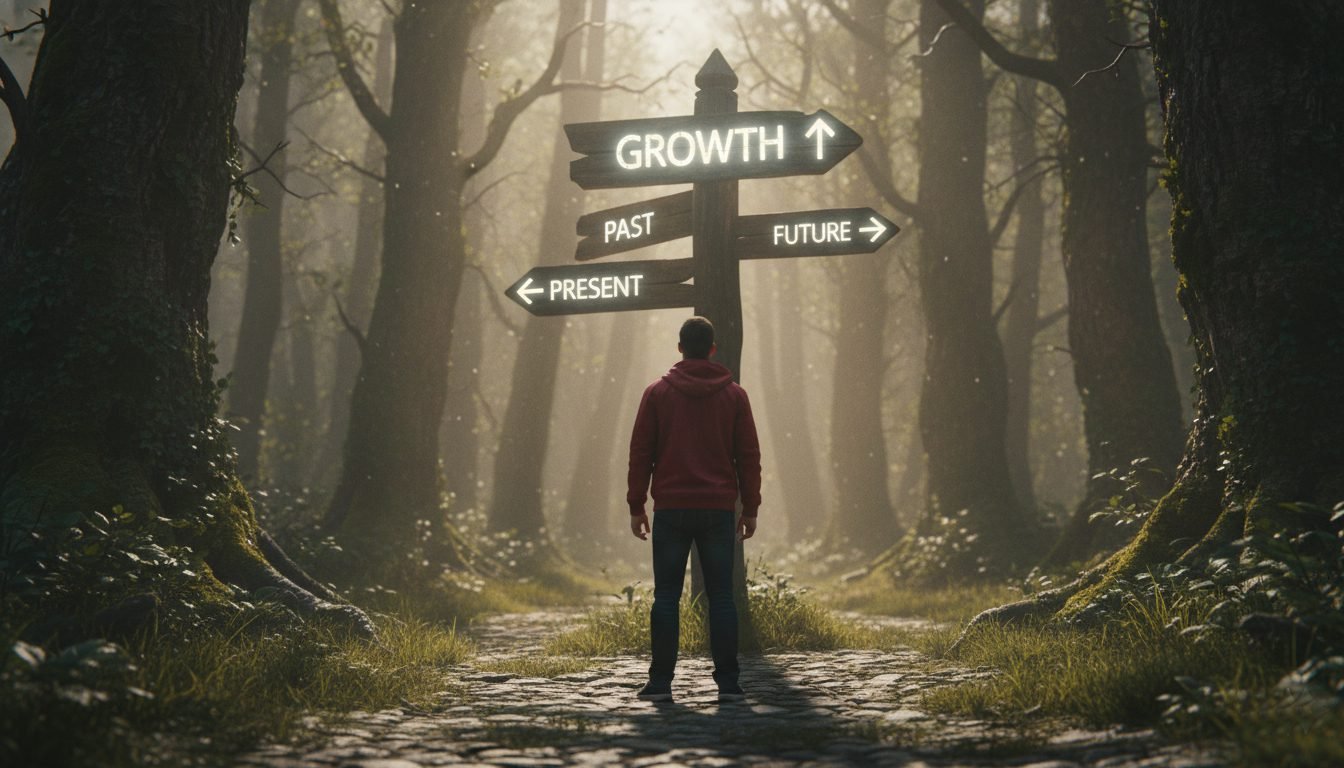

How can parents prepare children for AI future challenges without losing sight of the human qualities that matter beyond academic achievement, technology and employment?
We taught our children to think faster, remember more and compete harder.
Now machines are learning to do many of these things better than we can.
Perhaps it is time to question what we have been teaching them to value.
For generations, we taught our children to think faster and remember more. We taught them to solve problems and outperform others to prove they were competent.
We built whole education systems around these abilities. Success came to mean being
more efficient,
more productive
and more useful to the economic machine.
But what happens when machines do these things better than we can?
AI can already analyse faster, retain more information, and generate ideas in seconds. It can connect the dots, turn complex data into meaningful insights, and support informed decisions. Each year, it solves increasingly complex problems that take humans time.
So what happens to the abilities we spent generations training our children to master?
When memory and speed no longer give a child an advantage to be preferred over others, what will set one human being apart from another?
Perhaps it is the very qualities we once discouraged.
Questioning authority.
Challenging assumptions.
Thinking independently.
Many parents are quietly confused right now. You want to know which careers will survive and which degrees will still count. You want to know which skills will secure your child’s future.
These are important questions. But nobody can answer them with certainty. The world will keep changing, and today’s promising career may look very different tomorrow—especially given the rate at which technology is advancing.
Some of the more thoughtful people I know have started asking a different question.
Which relationship with AI expands intelligence, and which one replaces it?
This article is not another list of future-proof skills, career predictions or instructions on how to raise an AI-ready child. Its purpose is different. It is to help you question what you may have inherited about intelligence, education, success and parenting.
Before deciding what your child needs to learn, it is worth asking what you believe a child needs to become.
The aim is to build a foundation, not prescribe a formula. We want to help you see what truly matters, so you can read the changing world for yourself, adjust the gap, and make more conscious choices for your child over time. And so you can raise them to know what to look at, rather than follow the herd.
We cannot prepare our children for every possibility. But we can question how we are preparing them. We can notice what we may have overlooked. And we can give them space to grow qualities no exam can measure.
The challenge is not simply to prepare our children for the world that is coming. It is to rethink what we are preparing them to become.
Every Ability We Hand Over Begins to Weaken
The brain follows a simple rule. Use it or lose it.
Neural pathways in our brain that we use often grow stronger. Pathways we skip slowly weaken.
Let’s look at it with an example we can relate to. Think about how we used to find our way.
Before GPS, we carried maps in our heads. We remembered turns, landmarks and shortcuts.
Researchers studying London taxi drivers found something striking. Drivers who spent years learning the city’s streets had a larger hippocampus, the part of the brain linked to spatial memory.
Today, most of us simply follow the blue dot. Studies suggest that people who rely heavily on GPS tend to have weaker spatial memory.
We gained a navigation tool. We may have lost a navigation intelligence.
Now multiply that across everything AI is starting to do for us. Imagine the future.
When we hand over writing, we lose the skill of finding precise words to articulate difficult thoughts.
When we hand over research, we lose the patience to sit with a question until we truly understand it.
When we hand over decisions, we lose the ability to live with uncertainty and build judgement.
For adults, this is a loss. For children, it is bigger. These abilities are still being built.
A child cannot lose an ability they never had the chance to develop. They simply grow up without it.
Scary, isn’t it?
Thinking Partner or Thinking Replacement?
This is not an argument against AI.
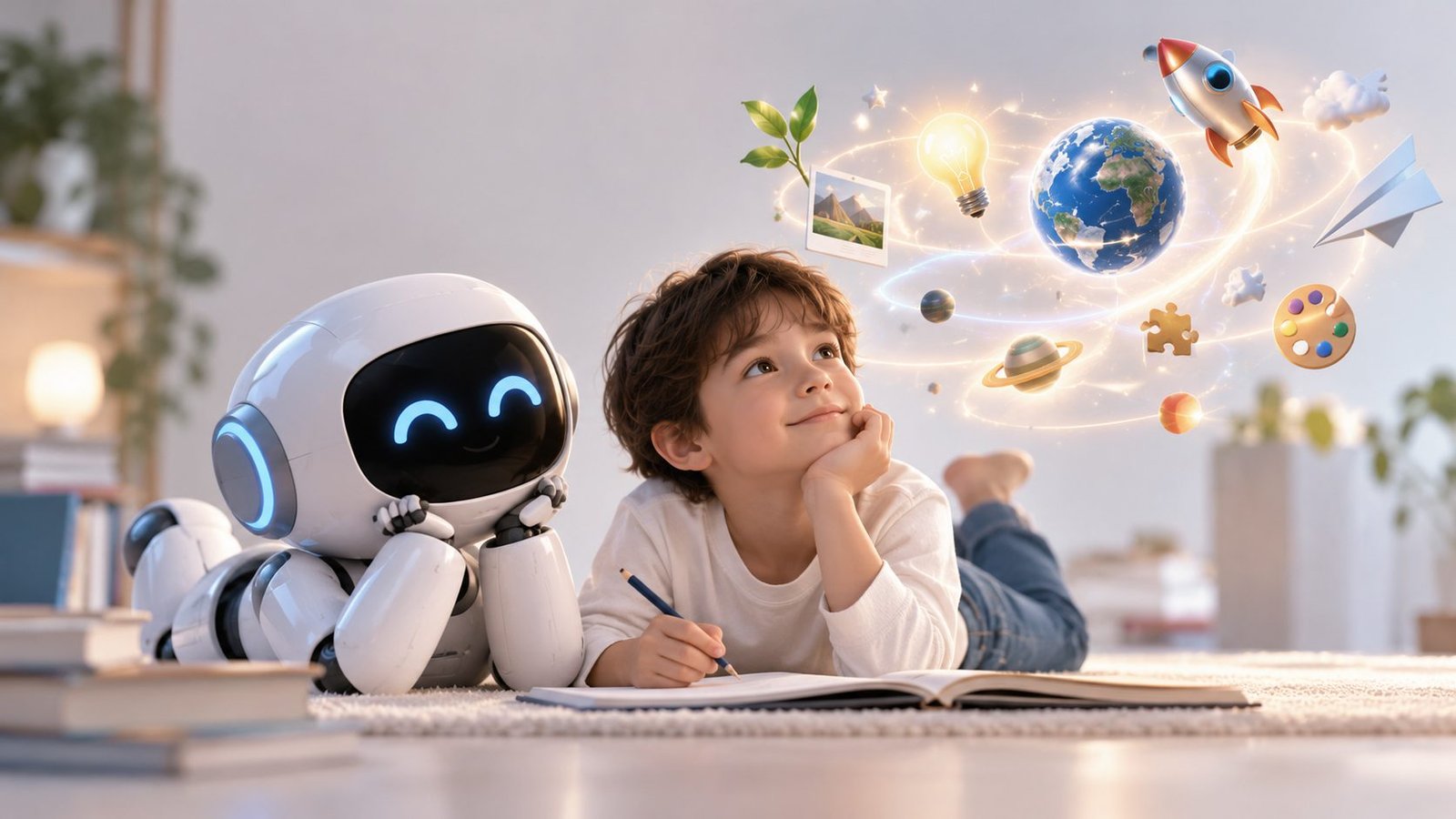
AI can be a wonderful companion for a growing mind. It all depends on the relationship we set with it.
For example, picture two children, each asked to write an essay on pollution.
The first types the topic into an AI tool. In seconds, a polished essay appears. She hands it in.
The second writes a rough draft first. Then he asks AI to argue against it. He pushes back, fixes the weak spots and rewrites it himself.
Both children used AI. Only one of them was thinking.
For the first child, AI was a replacement. She handed over the question and accepted the answer.
For the second, AI was a thinking partner. Something to argue with. Something to test his ideas against.
One relationship shrinks the mind. The other stretches it.
The difference is not the tool. It is whether your child is still doing the core thinking.
School is Preparing Children for a World That is Disappearing
Much of modern schooling took shape during the Industrial Revolution. It was built to produce reliable and obedient workers.
Show up on time.
Follow instructions.
Memorise.
Complete the task.
It worked well for its time. But that world is fading faster than the syllabus is changing.
I know this from my own life.
I was an average student. But I loved life science, and I badly wanted to become a doctor.
Back then, the profession was over-glorified. Still, I felt my interest was genuine.
The entrance exam of my time rewarded one thing above all. How much physics, chemistry and biology could I recall under pressure?
I wasn’t good at that. I knew it.
But something in me said this was the wrong test, the wrong criteria for selection. Memory alone could not show who would make a good doctor.
Today’s exam asks for more reasoning than it did then. But even now, a rank decides everything. No part of it looks for curiosity, empathy or the wish to understand.
I felt it strongly. But I couldn’t put it into words. And I didn’t dare question the norm.
As expected, I wasn’t selected. I studied life sciences and business instead.
The love for medicine never left.
When someone close to me falls ill, I still think it through like a scientist, with the limited knowledge my degree gave me.
I do my own research. I did it even in the days when Google was all I had. Often, I arrive at the same or a similar treatment to the one the doctor later chooses.
I don’t stop there. I look at the other treatments that could have been used for the same illness, and try to work out why this one was chosen. I learn what each prescribed medicine is meant to do, and what to expect along the way.
Sometimes I notice something worth asking about. I take it back to the doctor as a question, not a conclusion.
The doctor, of course, gets there with far deeper training and experience.
Then AI arrived.
Now I use it as a thinking partner.
I bring what I have: my analytical mind, my questions, my curiosity. AI brings a vast body of medical knowledge and research that no single person could ever hold.
Together, they fill much of the gap I was left with.
Let me be clear about what this is, and what it is not.
I don’t diagnose anyone. I don’t treat anyone. And I never use AI in place of a doctor’s advice.
AI can be wrong, so I check what it tells me. The final word always belongs to the doctor, who examines the patient, carries the experience and takes the responsibility.
What AI gives me is understanding. I finally grasp why a diagnosis was made and what a treatment is meant to do. And I walk into a consultation with better questions, the kind a rushed appointment often leaves unasked.
That is when I saw what the exam had missed.
The exam measured my memory, my ability to store facts and reproduce them on demand. That is exactly what a machine now does for us.
The part it ignored is the part that still matters.
My curiosity.
My need to understand.
My habit of asking why.
Technology has patched the knowledge I missed. It cannot supply the wish to know.
That is still very human. And it is exactly what we should be protecting in our children.
How many children are being turned away for the same reason today?
The world they are heading into is already changing. The World Economic Forum’s Future of Jobs Report 2025 expects about 170 million new jobs to be created by 2030, while about 92 million are displaced.
Routine work is shrinking. Information is already free.
The advantage will no longer belong to the child who knows the most. It will belong to the child who can think, build and lead.
UNESCO’s Guidance on Generative AI in Education and Research asks for a human-centred approach. Technology should support learning, not replace it.
How Human Intelligence Was Built, One Layer at a Time
In his book A Brief History of Intelligence: Evolution, AI, and the Five Breakthroughs That Made Our Brains, Max Bennett traces how the human brain came to be.
He describes five breakthroughs. Each one was built on the one before.
First came steering. Early worm-like creatures learned to move towards what was good and away from what was harmful.
Then came reinforcing. Early vertebrates learned from experience. They repeated what worked and avoided what didn’t.
Then came simulating. Early mammals could imagine an outcome before acting on it.
Then came mentalizing. Primates began to sense what others were thinking and feeling.
Last came speaking. Humans learned to put their inner world into words and share it.
Notice the order. Language came last. It sits on top of everything else.
When we speak, our words rest on a lifetime of feeling, doing, imagining and understanding others.
Today’s AI was built mostly on that last layer- Language. It learned language from vast amounts of text. It did not grow the layers beneath it the way a living brain did.
Bennett argues that this is why AI can sound wise without truly understanding the world it describes.
Many researchers see this as one of the biggest gaps between AI and the human brain. Teaching machines to imagine the real world, and to understand other minds, remains one of the hardest open challenges in the field.
AI can talk about the world. A child has to live in it.
This is exactly where a child is different from AI. Look at each layer.
Feeling what is good or harmful. A child touches a hot cup once and pulls back. The body remembers. AI can tell you a hot cup burns, but it has never felt heat.
Learning from consequences. A child who cheats at a game watches friends stop playing. The lesson sticks because the child lived it. AI learns from data. It never has to live with what happens next.
Imagining before acting. A child playing Jenga pictures the tower toppling before touching a block. So she leaves the risky one alone and picks a safer one. AI can explain why towers fall. It has never felt one wobble under its fingers.
Understanding other minds. A child notices Grandma is unusually quiet at dinner and asks if she is okay, though Grandma said nothing. A chatbot responds to the words you give it. It cannot sense what goes unsaid in a room.
Speaking. When a child says “I’m scared,” the words come from a real feeling. When AI writes the same words, it is arranging language.
Every one of these layers is built in childhood, through play, mistakes and real people. No screen can grow them for a child.
Let AI help with the words. But make sure your child is still building everything underneath.
What AI Cannot Do
Bennett’s layers point to something deeper still.
The kinds of intelligence AI cannot copy are exactly the kinds the world needs most today.
Presence. Being fully with another person.
Genuine empathy. Feeling what someone else feels.
The ability to sit with uncertainty without rushing to an answer.
The wisdom to know what should not be optimised.
The capacity to feel the weight of a decision, rather than just calculate its odds.
And consciousness itself. The awareness behind every thought.
AI can generate answers. It cannot decide which problems are worth solving. It cannot build trust between people, or find meaning for your child.
These are not small gaps waiting for a software update. They are what it means to be human.
Yet these are the very qualities most schools never teach.
So What Should We Actually Teach Our Children?
If knowledge is becoming free, more memorising is not the answer. Neither is more testing, or more obedience.
We need to teach what machines cannot do. Five things matter most.
Teach them how to think.
Most adults know what to think. Very few know how to think.
Reasoning, logic and good questions are the foundation. The World Economic Forum’s Future of Jobs Report 2025 lists analytical and creative thinking among the skills employers value most.
Above all, protect their habit of asking why. It is the part of the mind no exam measured and no machine can supply.
Teach them how to build.
Ideas. Projects. Small businesses. Communities.
Let them build with their hands, not just on screens. Let them experiment, fail and try again. Builders learn by doing, not by being told.
Teach them how to lead.
AI may manage systems. But the world will still need people who can share a vision, handle conflict and build trust.
Leading starts with understanding people. Reading a face. Sensing what goes unsaid.
That begins at home. With siblings, with friends and in family decisions.
Teach them to use AI as a partner.
Let your child bring the question and the judgement. Let AI bring the information.
Then teach them to check what it says, and to make the final call themselves.
It is the same way I use AI to understand a diagnosis. It sharpens my questions. It never replaces my judgement, or the doctor’s.
Teach them how to find meaning.
Even if machines solve many practical problems, your child will still face the oldest human question.
Why am I here?
Purpose, responsibility and service will matter more in an AI world, not less.
The Parenting Mistake We Must Not Repeat
When parents feel confused, they often prepare out of fear.
Coding classes. AI courses. Extra tuition.
None of this is wrong. But fear makes a poor guide.
Imagine a little girl who loves to draw. Before she has even explored it, someone asks, “But will that get you a job?”
From that day, she sees her drawing through her parents’ worry, which will eventually become hers too.
That is the difference between guiding a child and projecting our fears onto one.
As explored in our article See Through the Illusion (Before You Try to Change Yourself), clarity begins when we see that our beliefs may simply be conditioning.
Parents are not exempt. We want children to think for themselves, yet we get upset when they disagree with us.
As discussed in Step 2: See the Mind Clearly (Before You Trust It), thoughts and feelings come from conditioning. Just because they arise does not make them right.
And Step 3: How to Pause the Mind’s Automatic Reactions shows how to create a small pause between reaction and action. That one pause can change a conversation with your child.
We cannot teach children to think independently if we never examine the assumptions through which we ourselves think and parent.
What You Can Do at Home, Starting Today
You don’t need a new curriculum. You need ordinary moments, used well.
Ask open-ended, even strange, questions.
What if dinosaurs still lived among us?
If you could fix one thing in the world, what would it be?
These are not silly questions. They are how independent thinkers are made.
Let them solve their own problems. A child who works out why her Lego tower keeps falling is learning how systems work. A child whose parent fixes it is not.
Give them real responsibility. A small business idea. A family decision. A problem to solve without step-by-step instructions. Children trusted with real choices develop judgement.
Check AI together. Ask it a question at dinner, then ask your child: Is that right? How could we find out?
Harvard University’s Center on the Developing Child shares simple, age-appropriate activities that help children practise planning and self-control.
A Simple Practice: Ask Before You Answer
The next time your child brings you a question, hold back the answer.
First, ask:
- What do you think?
- What makes you think that?
- What else could be possible?
- How could you find out?
Give them time to think. Listen to their reasoning, even if it differs from yours.
If they are wrong, help them check. Ask them for their reasoning. Don’t just replace their answer with yours.
If they turn to AI, ask them to compare its answer with their own.
Watch yourself too. Are you really listening, or steering them towards an answer you already chose?
The purpose is simple.
Give your child space to think.
And give yourself a chance to see them clearly.
Perhaps We Need to Rethink What It Means to Prepare a Child for Life
We spent generations teaching children to remember, obey and compete.
AI now does much of that better than any of us. So the question has changed.
It is no longer whether your child will use AI. They will.
The question is whether AI will expand their mind or replace it.
That depends on the habits they build now. And it depends on you.
When you pause before reacting, you show them how to think. When you let them struggle a little, you let their mind grow.
Test scores fade. Tutors move on.
But the ability to think freely, build something real and find meaning stays for life.
If AI can increasingly provide our children with answers, are we helping them develop the ability to question those answers—or simply teaching them to accept whatever appears on the screen?
Continue the Journey: Back to You
Preparing children for an uncertain future begins with examining the assumptions that shape our own thinking. These three articles offer a starting point:
- Step 1: See Through the Illusion (Before You Try to Change Yourself) — Examine the assumptions and beliefs you may have accepted without questioning.
- Step 2: See the Mind Clearly (Before You Trust It) — Understand how thoughts, memories and conditioning influence the way you interpret situations.
- Step 3: How to Pause the Mind’s Automatic Reactions — Learn to recognise an automatic reaction before allowing it to determine your response.
The Takeaway
You don’t have to decide whether AI is good or bad for your child.
It is already part of their world. What matters is the relationship they build with it.
Used as a replacement, AI slowly does their thinking for them. Used as a partner, it stretches their mind.
The abilities that matter most are the ones no machine can supply. Curiosity. Judgement. Empathy. The courage to question.
AI has learned the words. Your child still has to build everything underneath.
These grow in ordinary moments at home. When you ask before you answer. When you let them struggle a little.
And they grow when you notice your own fear before it makes the decisions.
“I don’t need to know the future. I need to raise a child who can think for themselves in it.”
When your child keeps doing the thinking, AI becomes a tool for their growth, not a substitute for it.
Frequently Asked Questions
1. How should parents prepare children for the AI future?
Parents can help children develop relevant knowledge and technological skills while also encouraging independent thinking, curiosity, sound judgement, emotional understanding and responsibility. The aim is not to predict every future job but to help children learn, question and adapt as circumstances change.
2. Will artificial intelligence make human intelligence less valuable?
AI can already find information, write, analyse and solve problems. It can even help us weigh evidence and understand context. But that does not make human intelligence less valuable. AI works best as a tool that brings the facts to us. Judging those facts and deciding what matters should stay with people. That is a culture we need to build, at home and in school, so the final decision remains human.
3. Is AI bad for children’s cognitive development?
AI is not automatically harmful or beneficial. It can explain difficult subjects and support learning, but using it to bypass every challenge may reduce opportunities to practise independent reasoning. How children use AI, what they are learning and whether they still engage in the thinking process all matter.
4. Should children learn coding and AI skills?
Technology literacy can be valuable, and some children may develop a strong interest in coding or AI. However, no single technical skill guarantees future success. Parents should consider their child’s interests, educational needs and opportunities while encouraging the ability to question, learn and adapt.
5. Which skills will matter most in an AI-driven world?
No one can predict a definitive list of skills that will guarantee success. Analytical thinking, creativity, adaptability, technological literacy, communication, judgement and the ability to keep learning are useful capabilities to develop. Their value will vary depending on the person, profession and circumstances.
6. How can parents encourage independent thinking in children?
Ask children to explain their reasoning, consider different possibilities and examine evidence before accepting an answer. Allow age-appropriate opportunities to solve problems and make decisions. Offer guidance when necessary without automatically replacing the child’s thinking with your own.
7. How can parents use AI for their children’s education?
AI can help explain concepts, generate practice questions, offer feedback and introduce alternative viewpoints. Encourage children to attempt the task first when independent practice is important, evaluate AI’s suggestions and verify important information. Parents should also consider age-appropriate use, privacy and the limitations of AI-generated answers.
8. Why is self-awareness important in parenting?
Parents’ fears, expectations and past experiences can influence how they interpret a child’s behaviour and choices. Self-awareness helps parents recognise when they are responding to the child’s actual needs and when their own assumptions may be influencing the response. This creates more room for thoughtful guidance.
9. Should parents stop worrying about their children’s careers?
No. Education, career opportunities and financial independence are legitimate concerns. The important distinction is between helping children prepare for possibilities and assuming that one fixed path will guarantee their future. Parents can provide guidance while remaining open to change and respecting their children’s developing interests.
10. What is the most important thing parents can do for their children in the AI age?
There is no single action that guarantees a child’s future. A useful starting point is to examine your own assumptions, encourage your child to think independently, allow room for learning through experience and provide guidance without trying to control every outcome. The goal is to support the development of a capable person, not simply produce a successful student.
11. Why can’t AI understand the world the way a child does?
A child’s intelligence is built in layers: feeling what is good or harmful, learning from consequences, imagining outcomes, understanding other people and, last of all, language. As Max Bennett describes in A Brief History of Intelligence, language came last and rests on everything beneath it. Today’s AI learned mostly from text, so it can talk about the world fluently without having lived in it. A child builds those deeper layers through play, mistakes and real relationships, which is why they still matter so much.