

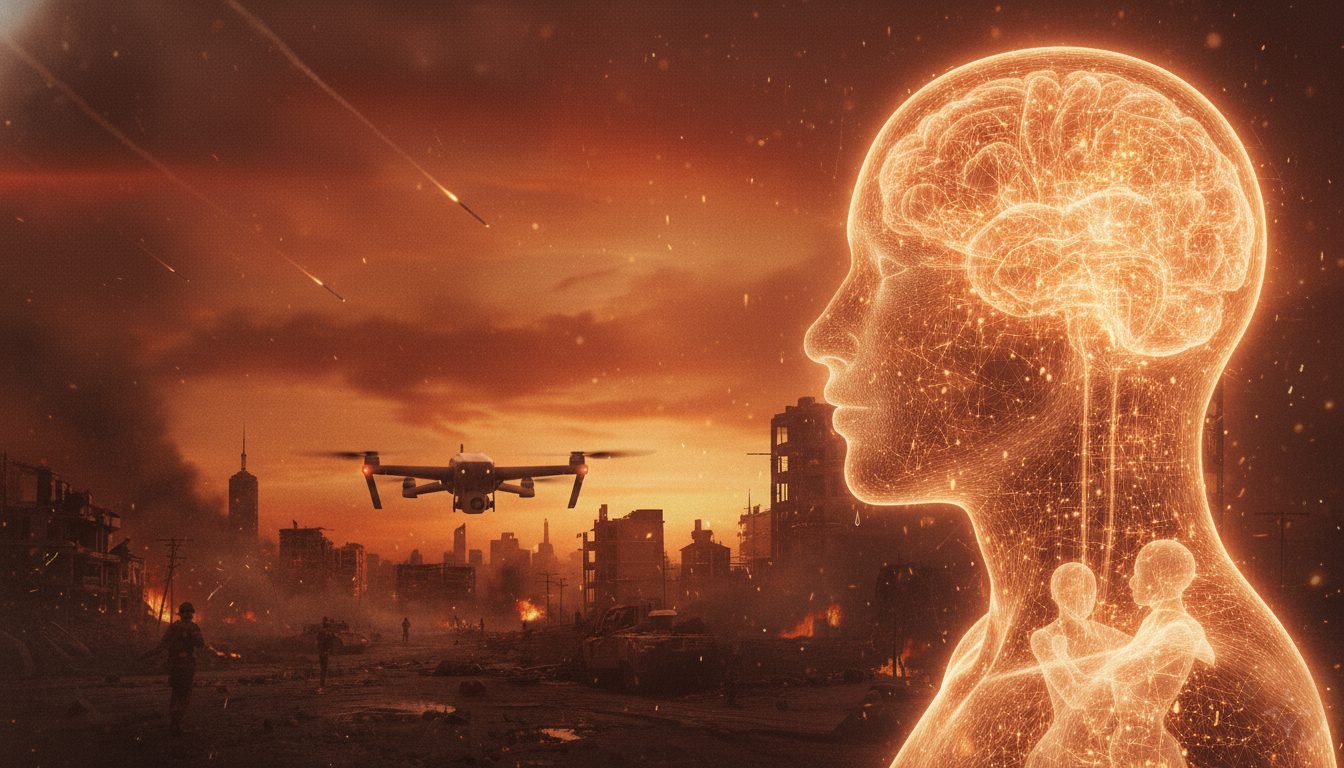
Iran Conflict 2025 dominates global headlines — the death of Iran’s Supreme Leader Ayatollah Ali Khamenei, Donald Trump’s response, regional tensions, military positioning.
But beyond geopolitics, beyond strategy and retaliation, there is a deeper question.
What does war reveal about the human mind?
If we look carefully, conflict does not begin with missiles.
It begins with perception.
What We See — And What We Miss
On the surface, war looks like nations clashing.
Iran. America. Alliances. Defense. Retaliation.
We debate who is right. We choose sides. We defend positions.
But beneath every political move lies something more fundamental.
Human suffering continues — because the mind reacts blindly.
War begins long before weapons are fired.
The Layers Behind Every War
Imagine the Iran Conflict 2025 as layers.
On the surface:
Nations. Politics. Religion. Strategy.
Below that:
Ideologies. Historical wounds. Cultural narratives.
Deeper still:
Fear. Anger. Insecurity. Identity.
At the core:
Human suffering.
Every system — religion, nationhood, governance — was originally created to bring order and safety.
But something subtle happens.
The mind takes identity from the system.
“My religion.”
“My nation.”
“My ideology.”
“My truth.”
The moment identity hardens, division begins.
It becomes: My belief versus yours.
This deeper structure of division is explored in Why Division Creates Inner Conflict.
And from there, conflict becomes predictable and inevitable.
Certainty, Belief, and the Ego
The Iran Conflict 2025 is not just a political disagreement.
It is certainty in action.
Notice something carefully:
You cannot go to war from “I don’t know.”
You cannot destroy from humility.
You cannot fight from uncertainty.
War requires conviction.
The ego thrives on “I know.”
“I know what is right.”
“I know who is wrong.”
“I know my side is justified.”
Certainty strengthens identity. Identity strengthens division.
This dynamic is examined more deeply in Identity Is the Hidden Problem Generator.
This pattern is not unique to Iran, America, Israel, or any specific nation.
This is a human pattern.
Watch Your Own Reaction
When you hear the name Ali Khamenei, something rises inside you.
Before careful examination — the mind has already categorized.
Based on the image you built over years.
Based on headlines.
Based on commentary.
Based on emotional impressions layered slowly over time.
Some immediately think:
“Ali Khamenei supports militant groups.”
“A hardline religious authority.”
“A symbol of anti-Western hostility.”
Others think:
“A defender of sovereignty.”
“A protector of cultural identity.”
“A leader resisting foreign pressure.”
Same name.
Different inner conclusion.
Now shift.
When you hear Donald Trump, something else appears.
Again — before nuance, the mind moves.
Some think:
“Erratic.”
“Dangerously unpredictable.”
“Fueling division.”
Others think:
“Strong.”
“Unapologetic.”
“Protecting national interests.”
Again — same name.
Different reaction.
Notice what just happened.
The name appears — and a conclusion follows.
Before nuance.
Before context.
Before full complexity.
The mind does not pause.
It categorizes.
And once it categorizes — it begins to defend.
And once it defends — it justifies.
This is not about Trump
This is not about Khamenei
This is not about Iran.
This is not about America.
This is about how the human mind operates.
Before analysis. Before context.
Reaction appears.
This is the mind operating through conditioning — religious, national, political.
When identity dominates intelligence, reaction replaces response.
This mechanism of narrative and reaction is explored in Break the Narrative and See the Mind Clearly.
The Emotional Fuel of War
Wars are rarely born from simple disagreement.
They are fueled by:
- Accumulated fear
- Stored anger
- Historical resentment
- Collective insecurity
Disagreement alone does not ignite conflict.
Emotion attached to identity does.
Think of a seesaw.
On one side: compassion and dialogue.
On the other: hatred and revenge.
The question is not whether both exist.
Which side are we loading?
Why Systems Cannot Guarantee Peace
Religions speak of peace.
Nations promise security.
Politics claims order.
Yet conflict continues.
Why?
Because systems regulate behavior — but rarely address the mechanism generating hatred.
If individual minds remain reactive, collective structures remain reactive.
The world is an amplified projection of individual minds.
If you cannot bring clarity to this small mind, how will the world become peaceful?
Inclusiveness or Exclusiveness
If identity is the fuel, then exclusiveness is the fire.
When identity becomes rigid, perception narrows.
When perception narrows, understanding collapses.
And when understanding collapses, conflict begins to feel justified.
“This is the only way.”
“This belief is superior.”
“This path is chosen.”
The language may differ — political, religious, national — but the mechanism is the same.
Exclusiveness does not always shout.
Sometimes it whispers.
It quietly filters perception.
It decides who belongs.
It decides who is right.
It decides who must be opposed.
This is how division sustains war — not only between nations, but between neighbors, communities, and even within one human mind.
Inclusiveness is not agreement. It is not a weakness.
It is intelligence free from rigid identity.
It is the capacity to see without being trapped by “mine.”
The Iran Conflict 2025 is not only a geopolitical crisis.
It is a visible expression of what happens when exclusiveness overrides awareness.
And that cannot be corrected in parliaments or battlefields alone —
It must be seen in the individual mind.
This deeper inquiry into belief and identity is explored in Demystifying God.
Can Force Ever Be Necessary?
Reality is complex.
There may be moments where force appears necessary to prevent immediate harm.
But even then, action must arise from clarity — not revenge.
From responsibility — not rage.
Otherwise, today’s protection becomes tomorrow’s resentment.
The cycle continues until someone stops reacting.
Where Real Peace Begins
It may sound unrealistic.
How can individual awareness influence global conflict?
Look carefully.
Every leader. Every soldier. Every policymaker. Every citizen.
Each is a human mind.
If minds remain reactive, institutions remain reactive.
If minds become conscious, institutions gradually shift.
Peace does not begin in treaties.
It begins in perception.
When you stop reacting from identity, you stop contributing to division.
That is not small.
That is foundational.
Take-Home Clarity
- War begins in perception before it manifests in weapons.
- Certainty strengthens ego; ego strengthens division.
- Emotion attached to identity fuels conflict.
- Systems cannot create peace if minds remain reactive.
- Awareness interrupts reaction.
- Peace begins with individual clarity.
Frequently Asked Questions
1. Is this article taking sides in the Iran Conflict 2025?
No. It examines the psychological mechanism behind conflict rather than geopolitical positions.
2. Are belief systems always harmful?
Beliefs become harmful when identity hardens around them and excludes others.
3. Can nations function without identity?
Functional identity is necessary. Psychological attachment that overrides intelligence creates division.
4. Is certainty always dangerous?
Certainty becomes dangerous when it eliminates openness to perspective.
5. How does individual awareness influence global peace?
Collective behavior emerges from individual minds. Reactive minds create reactive systems.
6. Does this mean self-defense is wrong?
No. It means action must arise from clarity rather than hatred.
7. Why do conflicts repeat throughout history?
Because identity-driven reaction remains unexamined.
8. What is the first practical step toward peace?
Notice your own reactions when encountering disagreement. Observation creates space for response.
Continue the Inquiry
If this reflection on the Iran Conflict 2025 resonated with you, explore further: