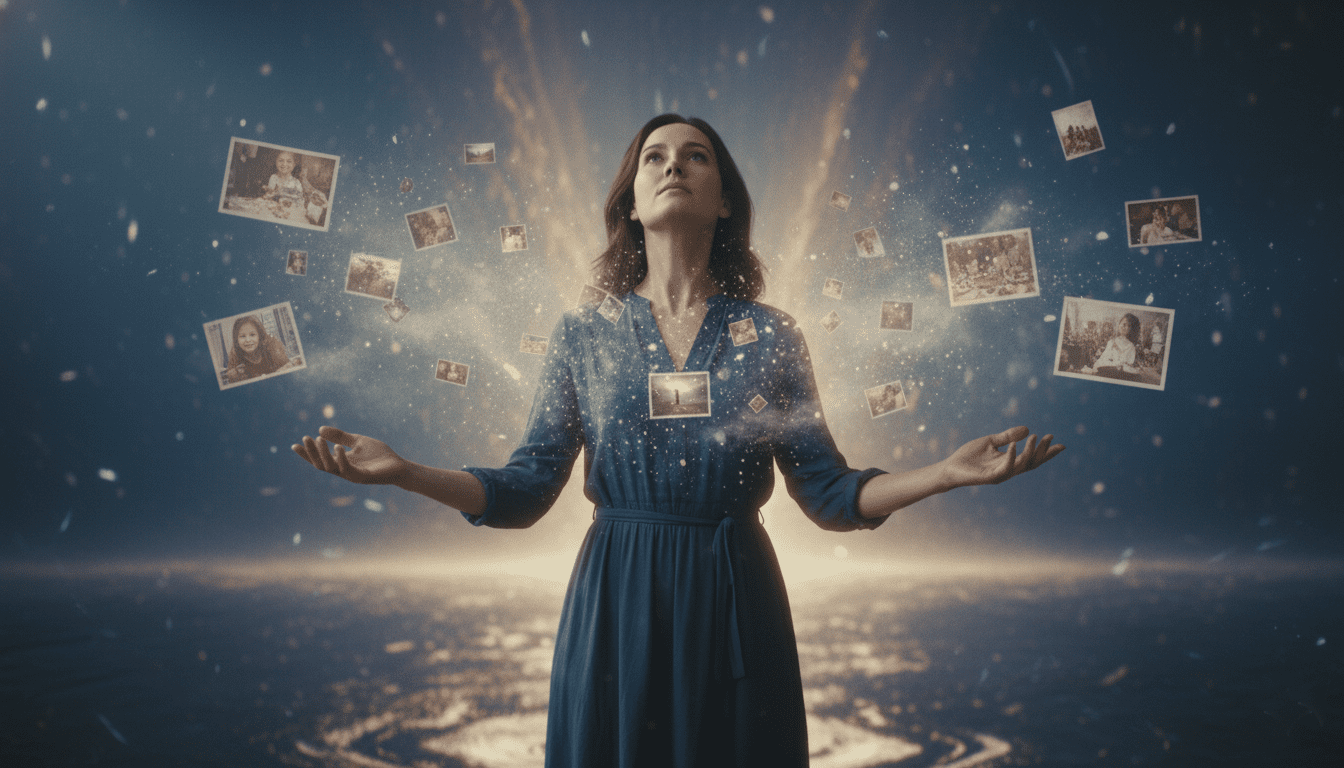


Time is the real trap that creates suffering by pulling attention away from what is actually happening now.
Notice Where Life Is Actually Hurting
Pause for a moment.
Right now, as you read this, what is actually happening?
You are sitting somewhere.
Your body is supported.
Your breath is moving on its own.
No argument is taking place in this moment.
No mistake is being made right now.
No loss is occurring in front of you.
And yet, there may be tension in the chest. A heaviness in the stomach. A sense of pressure or restlessness.
This is the first thing worth noticing.
Life, in the present moment, is often neutral.
The discomfort usually comes from somewhere else.
Most suffering comes not from what is happening, but from what the mind says about it.
Where the Mind Spends Most of Its Time
For most people, attention rarely stays with what is actually happening.
It moves constantly between two familiar places:
- What already happened
- What might happen next
The past shows up as memory.
The future shows up as imagination.
Both feel vivid. Both feel important. Both feel real.
But the point is, neither is happening now.
This movement of attention away from the present is so normal for most of us that it often goes unnoticed.
Yet this is where psychological suffering begins.
The mind lives in yesterday and tomorrow, while life happens only now.
It’s like this…
A person stands on a train platform.
The train they missed just left.
The train they need hasn’t arrived yet.
They stand between the two.
Replaying how they could have caught the first one.
Rehearsing what they’ll do when the next one comes.
Meanwhile, their feet are on solid ground.
The air is cool. Birds are nearby. The sun is out.
But none of this registers.
They are mentally elsewhere.
Not on the platform that missed them.
Not on the train that hasn’t come.
Stuck between two moments that aren’t happening.
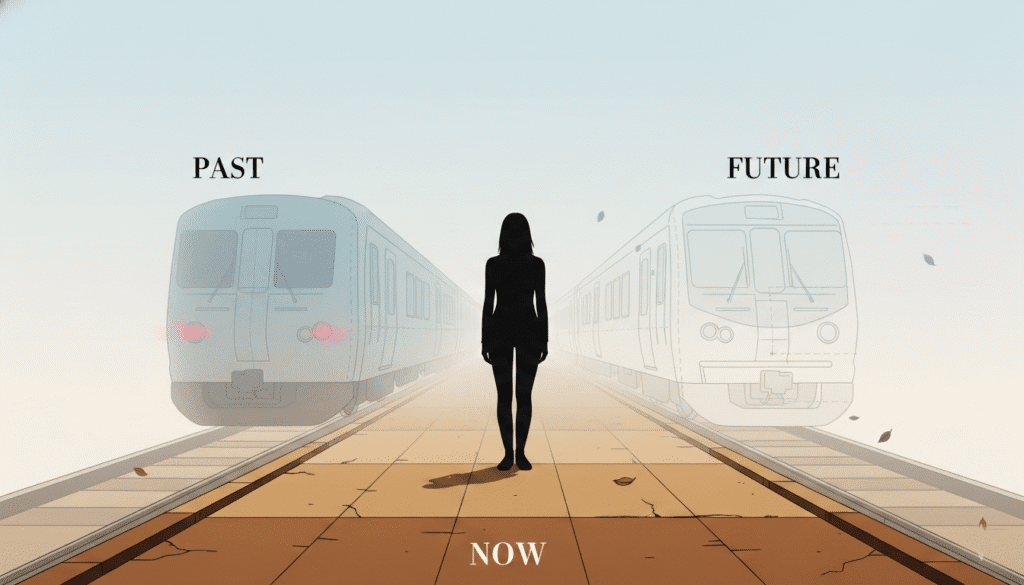
This is where most people live.
Not in the past or future themselves.
But in the gap between them.
Never quite here.
Clock Time vs Psychological Time
There is nothing wrong with time itself.
Clock time is practical. You need it to plan a day, meet someone, or organise work.
Psychological time is different.
It is the habit of mentally revisiting what is over and mentally rehearsing what has not yet arrived.
Clock time helps life function.
Psychological time keeps life on hold.
It quietly convinces you that peace, ease, or resolution exists somewhere other than now.
It’s like this..
The Map.
A map shows you how to reach a destination.
Useful. Practical. Clear.
But imagine carrying the map everywhere.
Even after you’ve arrived.
Even when you’re sitting in your own home.
You keep checking it. Studying it.
Worrying about routes you’ve already taken or might need later.
The map was meant to guide movement to this moment.
Now it replaces the experience of being anywhere.
Clock time is the map.
Psychological time is never putting it down.
A Small Everyday Example
You say something awkward in a conversation.
The moment passes.
The other person moves on.
Life continues.
Later that evening, the mind replays the scene.
“Why did I say that?”
“That sounded stupid.”
“They must be judging me.”
The event itself is finished.
The discomfort is not.
This discomfort is not coming from the present moment.
It is coming from a thought about the past that the body is responding to as if it were happening now.
How the Past Stays Alive
The past does not have the power to hurt you.
Memory does.
When a memory appears, the body does not know it is a memory.
The same sensations arise:
- The chest tightens
- The stomach contracts
- The breath becomes shallow
The body responds to sensation, not to dates or timelines.
This is why experiences from years ago can still feel emotionally fresh.
The mind has taken something that is over and turned it into a present experience.
The past hurts only when it is replayed as the present.
The Future Works the Same Way
The future has not arrived.
But anticipation has.
The mind imagines a scenario:
“What if this goes wrong?”
“What if I fail?”
“What if I lose this?”
The body reacts instantly.
Anxiety appears.
Urgency builds.
Nothing has happened.
Yet the suffering feels real.
This is because the body reacts to imagined situations exactly the same way it reacts to real ones.
Most of the time, what is imagined never actually happens too.
Anxiety is often the body reacting to events that do not exist.
Why Time Feels So Convincing
Time feels convincing because thought feels convincing.
This is why time is the real trap for the mind — it keeps attention moving away from life as it is.
When you are identified with thinking, whatever the mind produces feels like reality.
A memory feels like truth.
An imagined future feels like certainty.
This is why time becomes such an effective trap.
You are rarely here.
You are constantly correcting, preparing, or replaying.
And the worst – You are missing now, the present, the real
The Cost of Living in Psychological Time
When attention lives mostly in the past or future:
- Simple moments lose depth
- Peace feels postponed
- Life feels incomplete even when nothing is missing
You may notice this as constant mental noise.
Or as background anxiety.
Or as a feeling that life hasn’t properly started yet.
None of this means something is wrong with you.
It means attention is not where life is happening.
What the Present Moment Actually Is
The present moment is not an idea.
It is not something you achieve.
It is what remains when thought pauses. It is the reality that exists now.
The sensation of sitting.
The sound in the room.
The taste of the food you are eating.
The joy you feel when your loved ones are around.
The simple fact of being here, being alive.
The present moment does not need improvement.
It only needs to be noticed.
Important Clarification: This Is Not About Escaping Time
This is crucial to understand.
You are not being asked to stop planning.
You are not being asked to forget the past.
You are being invited to notice when time stops being practical and starts becoming psychological weight.
Use time when it serves.
See it when it doesn’t.
What Changes When Time Is Seen Clearly
When psychological time is recognised for what it is:
- Urgency softens
- Attention returns naturally
- Life feels fuller without changing circumstances
Nothing dramatic happens.
Life simply stops being postponed.
You are finally where you already are. The only reality that is there now.
Related Clarity
- The Mechanical Mind: Why Life Feels Repetitive
- Awareness vs Identification: The Point Where Freedom Begins
- Why Happy People Do Less
Take-Home Clarity: What This Article Really Points To
If this article could leave you with a few simple reminders, let them be these:
- The present moment is often neutral; suffering usually comes from past or future thinking.
- Psychological time keeps attention trapped in memory and imagination.
- The body reacts to remembered or imagined events as if they are happening now.
- Most anxiety and regret arise from experiences that are not actually occurring.
- Planning is useful, but living mentally in time postpones life.
- Peace is not found in a future moment but in returning attention to what is already here.
- The present moment does not need fixing — only noticing.
- Freedom begins when attention returns to where life is actually happening.
Life is rarely hurting now.
Suffering comes from living somewhere else in thought.
And seeing this is the beginning of coming back to where life already is.
FAQs
Why is time described as a trap?
Because psychological time pulls attention away from present experience and turns thought into ongoing suffering.
Is thinking about the future always harmful?
No. Planning is useful. Suffering begins when imagination is mistaken for reality.
Why does the past still feel painful?
Because memory triggers bodily reactions as if the past were happening now.
Does living in the present mean ignoring responsibilities?
No. It means responding to what is real instead of reacting to mental images.
What is the first sign of freedom from psychological time?
A reduction in urgency and a sense of being more at ease where you are.