


Discover awareness by learning to recognise the quiet presence behind your thoughts, emotions, and reactions.
Welcome to Phase 2 — Essence.
You’ve completed the Observation phase: noticing autopilot reactions, seeing the stories the mind tells, pausing before you react, and recognising old emotional imprints. Those steps built necessary clarity. Now the journey becomes deeper. Phase 2 asks a different question: what remains when the noise settles? This phase is about discovering the steady presence — the awareness — beneath all mental movement. It is the pivot from understanding the mind to recognising the one who sees the mind.
Discover awareness. Imagine sitting inside a metro train. The train is moving fast, but your body feels still in your seat while the world outside keeps changing — stations, lights, buildings, and faces passing by in constant motion.
You see the movement, but you are not the movement.
This is the first glimpse of awareness. Life moves. The mind moves. Emotions move. But something in you doesn’t move.
Step 5 is about discovering that unmoving space — the awareness that remains steady while everything else shifts.
In Step 1, you paused the mind’s automatic reactions. In Step 2, you saw how stories colour your moments. In Step 3, you learned to witness thoughts without becoming them. In Step 4, you began softening the old imprints that hijack your present.
Now, in Step 5, you turn toward the one constant behind all of this — awareness itself.
The Most Overlooked Part of Your Experience
You notice your thoughts. You notice your emotions. You notice impulses and reactions. But rarely do you notice the one who notices — the quiet, steady presence behind it all. This presence doesn’t change with your moods. It doesn’t argue. It doesn’t wobble.
Awareness is the steady observer inside you — the one part of you life cannot shake.
Movement Outside, Stillness Inside
In the metro, the outside world rushes by — tunnels, buildings, platforms, lights — all moving in their own rhythm. Inside your seat, you remain still. You aren’t trying to control the movement outside. You simply see it.
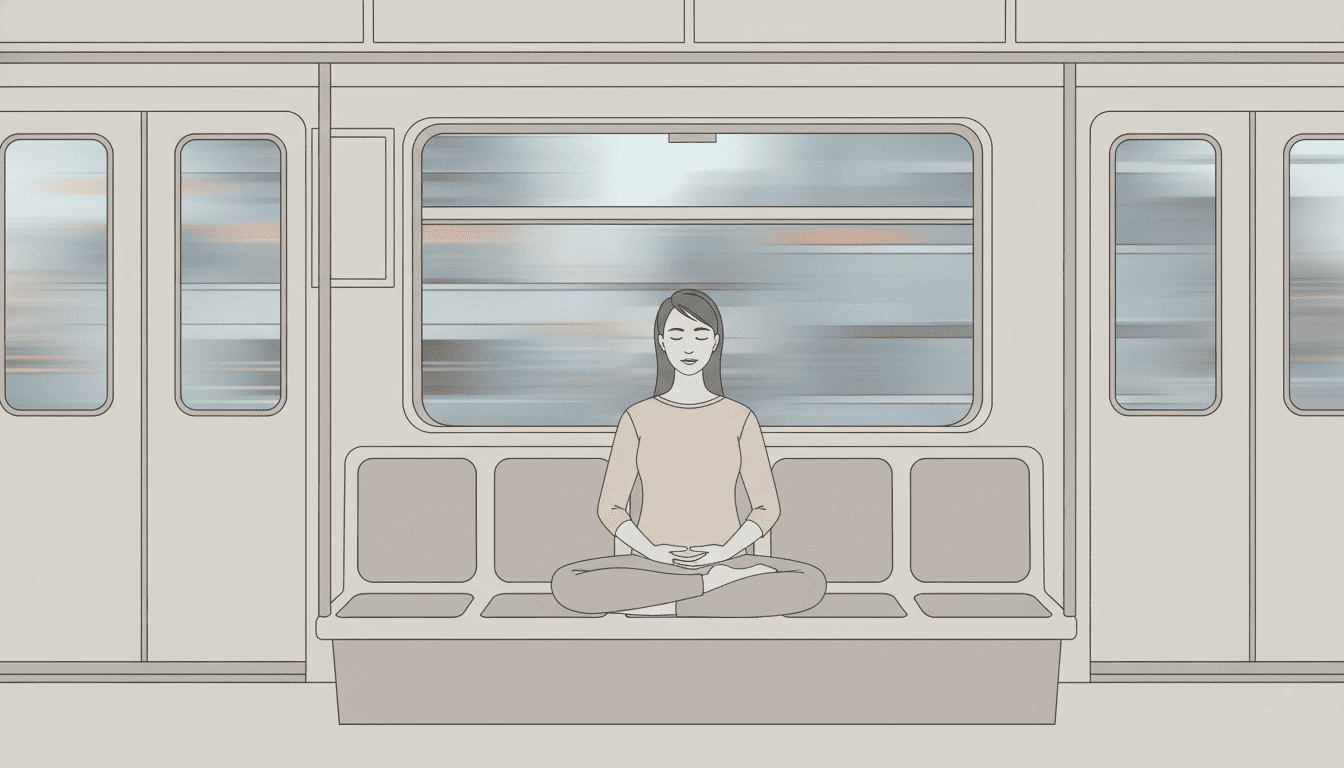
This is awareness: the inner space that watches thoughts, emotions, and sensations without being pushed around by them. You are the observer in the carriage — not the scenery outside.
Most people live leaning out of the window, reacting to every passing scene. Step 5 teaches you to sit back in the seat — the stable position of awareness.
The Screen and the Movie
Imagine watching a movie projected on a screen. The story is intense — fire, heartbreak, chaos, celebration. Characters scream, cry, succeed, fail. But the screen is untouched. It doesn’t burn. It doesn’t break. It doesn’t react.
Your awareness is the screen. Thoughts are the movie.
The movie keeps changing, but the screen does not. When you discover awareness, you stop living inside the drama. You begin to watch it with clarity.
If Thoughts and Emotions Aren’t You, What Is?
You are not your thoughts — they come and go. You are not your emotions — they rise and fall. You are not your reactions — they depend on triggers. You are not your stories — they were learned. You are not your past — it appears only when remembered.
So what remains? The awareness that sees all of this.
Awareness is like a clean mirror which reflects everything perfectly: a beautiful face, an ugly face, a cup, a tree. It doesn’t hold onto any image. The second the object moves, the mirror is ready for the next thing, without judgment or memory.
Your awareness is like that. It reflects a happy thought, then a worried one, then a memory, then a sound—instantly, without sticking.
As a practical nudge to understand it: For a few moments, try to act like a mirror. Just let thoughts and sensations come and go without following them. Don’t try to stop them. Just don’t grab on. See if you can feel the difference between the thought and you, the thing noticing the thought. It’s subtle but powerful.
Awareness is here before a thought appears, during it, and after it fades. It is the one part of you that doesn’t change. And what doesn’t change is the real truth.
Why Awareness Is Easy to Miss
Awareness is silent. Thoughts are loud. Awareness is steady. Emotions are dramatic. Awareness does not demand attention. Stories do.
You overlook awareness for the same reason you overlook the space in a room. Space doesn’t call for attention — but nothing exists without it.
Awareness is the background of every experience. You miss it only because it is always here.
Discovering Awareness in Real Time
Try this simple experiment right now: wait for your next thought. Before the thought arrived, something was already here — able to notice. During the thought, that same presence continued observing. After the thought ended, the presence remained.
That unchanging presence is awareness.
Thoughts arise and pass. Emotions come and go. Awareness stays.
Awareness Is Not Passive or Detached
Awareness doesn’t make you passive or emotionless. It makes you less entangled. You still participate fully in life — but with clarity instead of confusion.
Awareness doesn’t remove life. It removes distortion.
What Changes When You Discover Awareness
Awareness subtly transforms how you move through life:
- Emotions feel lighter because you stop becoming them.
- Thoughts lose authority because they no longer define you.
- Reactions soften because you are less pulled by automatic patterns.
- Stories fade because you see them forming.
- You become less affected by others’ behaviour because you’re anchored in clarity.
Life doesn’t become perfect — but it becomes far more spacious.
Practical Exercise: The Observer Test
For the next 24 hours, try this:
- Whenever a thought appears, notice it as if it were scenery passing outside the train window.
- Say quietly: “I am the observer, not the movement.”
- Pause for a second and feel the stillness that remains even as the thought changes.
- Return to what you were doing with that sense of inner steadiness intact.
This is how awareness moves from concept to experience.
FAQs
1. What does it mean to discover awareness?
Discovering awareness means recognising the part of you that notices thoughts, emotions, and sensations. Instead of identifying as the mind’s content, you begin to see that there is a steady presence behind everything you experience. This awareness is not created; it is already here. Step 5 helps you notice it directly.
2. Is awareness the same as consciousness or attention?
Awareness is broader than attention. Attention focuses on a specific object, thought, or sensation. Awareness is the space in which attention, thoughts, emotions, and sensations appear. You can shift attention, but awareness itself remains constant.
3. If I am awareness, does that mean thoughts and emotions are bad?
No. Thoughts and emotions are natural functions of the mind and body. Step 5 does not ask you to reject them. It simply shows you that they are experiences happening within awareness, not definitions of who you are. When you stop identifying with them, they function more healthily.
4. How is discovering awareness different from witnessing thoughts in Step 3?
Step 3 teaches you to witness thoughts instead of reacting automatically. Step 5 goes deeper by pointing directly to the witness itself. Instead of focusing on what is being observed, you recognise the observing presence that has always been there.
5. Can awareness be lost once it is discovered?
No. Awareness cannot be lost because it is not something you achieve. It can be overlooked when attention becomes absorbed in thoughts or emotions, but the moment you notice this absorption, awareness is already present again.
6. Will discovering awareness make me detached from life or people?
No. Awareness does not create detachment; it reduces entanglement. You still feel emotions, care about people, and participate in life. The difference is that you respond with clarity instead of being overwhelmed or pulled into automatic patterns.
7. Why does awareness feel subtle or hard to notice at first?
Awareness feels subtle because it does not announce itself. Thoughts are loud, emotions are dramatic, and stories demand attention. Awareness is quiet and steady. Because it is always present, the mind overlooks it — much like you overlook the space in a room.
8. Do I need meditation or silence to experience awareness?
No. Awareness is available in ordinary moments — while walking, working, listening, or speaking. Formal meditation can help, but Step 5 emphasises direct recognition in daily life, not special conditions.
9. Is discovering awareness an intellectual understanding or an experience?
It begins as a recognition, not a belief. You may understand it conceptually at first, but its real value comes from repeatedly noticing awareness in lived moments. Each recognition makes it more familiar and stable.
10. How does discovering awareness change daily life?
As awareness becomes clearer, thoughts lose authority, emotions feel less overwhelming, and reactions soften naturally. Life does not become problem-free, but it becomes more spacious, grounded, and easier to navigate without inner friction.