


Awareness vs identification explains why thoughts feel personal, authoritative, and difficult to step away from.
The Invisible Shift That Changes Everything
A thought appears.
It could be ordinary:
“I shouldn’t have said that.”
Or heavy:
“Something is wrong with me.”
Nothing dramatic happens on the surface.
No alarm goes off. No warning appears.
And yet, in a fraction of a second, the body tightens. The mood shifts. The inner atmosphere changes.
This change does not come from the thought itself.
It comes from a subtle, usually unnoticed movement: the moment the thought is taken to be you.
This is the point where awareness is replaced by identification.
A thought becomes suffering only when it becomes ‘me’
What Awareness and Identification Actually Mean
Awareness and Identification are not abstract ideas.
They describe two very different ways of relating to experience.
Awareness means a thought is noticed.
Identification means a thought is believed.
In awareness, a thought is something that appears. Something that appears without triggering any effect on you.
In identification, a thought becomes a statement about who you are, what life is, or what must be done.
The content of the thought may be the same in both cases.
The difference lies entirely in whether there is distance or fusion.
That difference determines whether there is freedom or compulsion.
Awareness notices a thought. Identification lives inside it.
Position, Not Content
Imagine sitting in a theater.
The lights dim. The film begins.
At first, you notice the screen. You hear the speakers. You feel the seat beneath you.
You are watching something unfold.
Then the story pulls you in.
A character is in danger. Your chest tightens. Your breathing changes.
Someone on screen is humiliated. Your face flushes with secondhand shame.
A jump scare appears. You physically flinch.
Nothing left the screen.
Nothing entered the theater.
And yet your body responded as if the threat were real.
This is identification.
Now imagine remembering, mid-scene, that you are in a theater.
The film continues. The danger on screen has not changed.
But suddenly there is distance.
Your body relaxes. The tension drops.
You are no longer inside the story.
You are watching it unfold.
This is exactly how thoughts work.
Thoughts themselves are not the problem.
Identification is forgetting you are in the theater.
Why Thoughts Feel So Convincing
A thought doesn’t wait to be verified. The reaction happens first.
By the time you question a thought, the damage is already done.
When identification is active, there is no gap between the thought and the sense of self.
The thought is not evaluated.
It is lived from.
This is why:
- An imagined future can create real anxiety
- A memory can trigger physical reactions
- A single sentence in the mind can colour an entire day
The body responds as if the thought were a fact.
Because, in identification, it is.
When identification happens, imagination feels like reality.
Identification Is Not a Personal Failure
This point matters deeply.
Identification is not a mistake you made.
It is a conditioned habit you inherited.
From childhood, you were encouraged to:
- Trust your thoughts
- Defend your opinions
- Define yourself through thinking
No one pointed out that thoughts come and go.
No one highlighted that something remains aware of them.
So identification became normal.
Not because it is true — but because it was never realised and questioned.
What Awareness Actually Is (Without Misunderstanding)
Awareness is often misunderstood as effort.
It is not concentration.
It is not vigilance.
It is not watching closely.
Awareness is simply the capacity to notice what is happening without becoming it.
Thoughts continue.
Emotions continue.
Life continues.
The difference is that thoughts and emotions are noticed, instead of pulling you in without choice.
Why Awareness Is Already Present
You do not create awareness.
If you did, you would not know when you lost it.
Awareness is present even in distraction.
It is present even in confusion.
You know you were distracted only because awareness noticed it.
You know you were lost in thought only because awareness returned.
This means awareness was never absent.
Only attention moved. Or something else took the precedence when awareness should have been the first to come and take charge.
The Real Shift: From Content to Context
Freedom does not come from changing the content of thoughts.
It comes from recognising the context in which they appear.
When thoughts are seen as events within awareness rather than definitions of reality, their authority weakens.
Not through resistance.
Through clarity.
Freedom begins when thoughts are seen as events, not commands.
The mind loses its grip not because it is fought, but because it is seen.
Important Clarification: This Is Not Detachment
This point needs to be clear.
Awareness does not make you passive.
It does not disconnect you from life.
Action still happens.
Decisions are still made.
The difference is that action arises from clarity rather than compulsion.
You respond instead of react.
The Beginning of Real Freedom
Freedom does not arrive dramatically.
It begins quietly.
With the simple recognition:
“A thought is happening — and I am aware of it.”
A radio plays a song.
Loud or soft. Chaotic or calm.
The radio does not become the song.
It allows the song to pass through.
When the song ends, the radio remains unchanged.
Now imagine the radio forgot what it was.
Imagine it believed it was the song.
Every note would feel personal.
Every lyric would define it.
A sad song plays: “I am sadness.”
A soothing song plays: “I am calm.”
It lives and dies with each track.
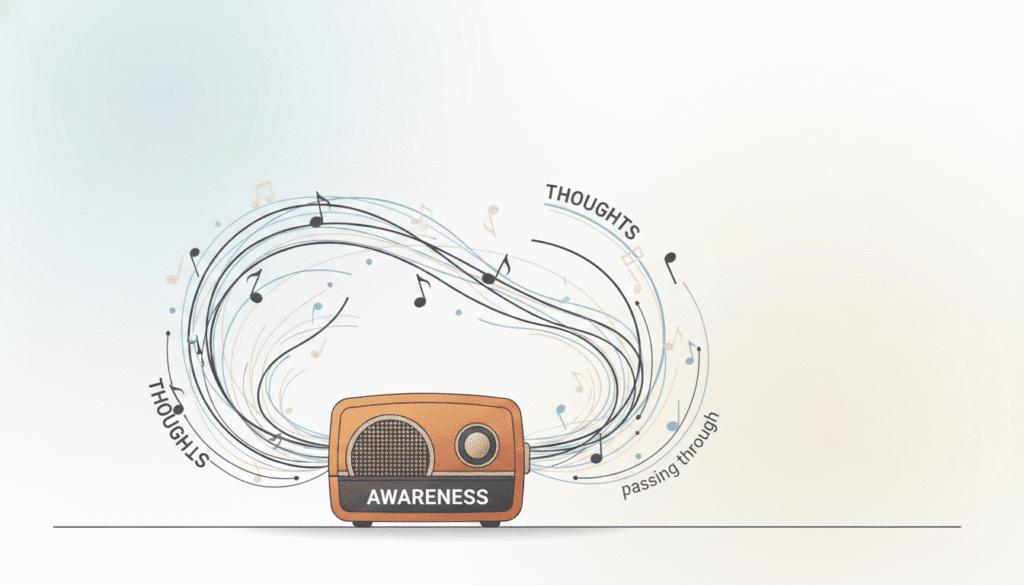
This is identification.
You are not the thoughts passing through.
You are the space in which they appear.
Identification is forgetting you are the radio.
Awareness is remembering.
That recognition creates space.
And in that space, something fundamental shifts.
You are no longer inside the movie.
You are watching it.
Related Clarity
If this distinction resonates, you may also want to read:
The Mechanical Mind: Why Life Feels Repetitive
See how unconscious identification turns life into repeating patterns.
Responding Instead of Reacting
Explore how awareness naturally replaces automatic reaction in daily life.
Meditation
Why awareness is not something you practice, but something you notice.
Take-Home Clarity: What This Article Really Points To
If this article could leave you with a few simple reminders, let them be these:
- A thought only becomes powerful when it is mistaken for who you are.
- Awareness means noticing thoughts; identification means becoming them.
- The problem is not thinking, but losing distance from thoughts.
- Freedom begins when thoughts are seen as events, not truths.
- Awareness does not remove life’s challenges — it removes unconscious reactions to them.
- You do not need to create awareness; you only need to notice when identification happens.
- Action continues, but it becomes clearer when not driven by mental compulsion.
- The real shift is from being inside the story to watching it unfold.
You are not the thoughts passing through.
You are the space in which they appear.
And remembering this is where freedom quietly begins.
FAQs
What does awareness vs identification mean?
It refers to the difference between noticing thoughts and believing them as who you are.
Do thoughts stop when awareness is present?
No. Thoughts continue, but they lose authority when they are seen rather than followed.
Is identification a bad habit?
No. It is unconscious conditioning, not a personal failure.
Does awareness make life passive?
No. Awareness allows clearer engagement with life, not withdrawal.
Can awareness be forced?
No. Awareness is revealed through seeing, not created through effort.
What is the first sign awareness is functioning?
The first sign is space — a pause where reaction used to be automatic.