

Responsibility without blame means recognising your response to life as it is, without turning experience into guilt, fault, or inner punishment.
Why Responsibility Immediately Feels Heavy
For most people, responsibility does not arrive as clarity. It arrives as pressure.
The word itself carries emotional weight. It feels like something went wrong. It sounds like judgment. It hints at consequences.
This reaction did not come from nowhere.
Early in life, responsibility was rarely taught as awareness. It was taught as a correction. When mistakes happened, responsibility meant someone was at fault. Someone had to explain. Someone had to carry the burden.
Over time, the nervous system learned a simple association: Responsibility equals danger.
Responsibility became heavy only because it was taught through finding blame
So later in life, when responsibility appears, the body reacts before understanding can step in. Defensiveness arises. Justification follows. Blame appears quickly, not because it is wise, but because it feels protective.
This is why responsibility is often avoided, resisted, or misunderstood. It has been conditioned as threat instead of power.
How Blame Quietly Removes Your Power
Blame feels active, but it is immobilising.
The moment blame appears, attention leaves the present moment. It moves toward causes, reasons, and explanations. Who said what. Who did what. Who should have known better.
Sometimes blame points outward, toward people, situations, or timing. Sometimes it turns inward, toward your personality, your past choices, or perceived flaws.
Either way, the effect is the same.
Attention is no longer with what is happening now.
And where attention goes, power follows.
You may feel justified while blaming. You may feel morally right. But at the same time, you will feel stuck.
Blame freezes life at the point of error. Responsibility without blame allows movement.
Blame looks backward. Responsibility moves forward.
What Responsibility Actually Means
Responsibility has nothing to do with fault.
At its simplest level, responsibility means the ability to respond.
Responsibility is not about finding fault — it is about what you do next.
Nothing more.
It does not demand that you explain why something happened. It does not require you to accuse yourself or others. It does not ask you to carry unnecessary weight.
It simply notices what is happening now and recognises that a response is possible.
This response may be internal or external. It may involve action, communication, waiting, or stepping back.
The key distinction is simple but essential.
Responsibility stays with what is alive in the present. Blame stays with what is already over.
How This Looks in Ordinary Moments
The Locked Door
You arrive home and find the door locked.
Your keys are inside.
You could stand there replaying how this happened.
Whose fault it was. What you should have noticed. Why you’re always doing this.
Every minute spent in that story is a minute still standing outside.
Or you could call a locksmith.
The locksmith doesn’t need to know whose fault it is.
The door doesn’t care about the story.
Only your response matters now.
Blame keeps you locked out.
Responsibility gets you inside.
Why Blame Feels Safer Than Responsibility
Blame feels safer because it creates certainty.
Blame answers the question: “Whose fault is this?”
Once that question is answered, something settles.
The mind has a story. A reason. An explanation.
If someone else caused it, you are off the hook.
If circumstances caused it, there was nothing you could do.
Either way, the discomfort of uncertainty disappears.
Responsibility without blame offers no such relief.
It does not ask whose fault it is.
It asks: “What now?”
That question has no clear answer.
No one to point to. No explanation that closes the loop.
Just the open space where a response is needed.
That openness feels uncomfortable.
But it is also where power lives.
Because “whose fault is this?” keeps you looking backward.
“What now?” brings you here.
And here is the only place life can actually change.
The Sudden Rain
You’re walking outside.
Rain starts falling.
Heavy, cold, unexpected.
You could stand there arguing with the weather.
Resenting the forecast. Blaming yourself or your partner for not checking it. Cursing the timing. Reminding yourself that you were not responsible.
While you argue, the story feels complete.
You know whose fault it is. You understand what went wrong. The certainty feels solid.
But the rain doesn’t stop.
You just get wetter.
Finding shelter means stepping into uncertainty.
You don’t know if there’s a doorway nearby. You don’t know how long the rain will last. You don’t know if your choice will work.
But you’re moving.
And movement is where power lives.
A Situation Most People Recognise Instantly
Someone speaks sharply to you.
The words land. The body tightens. The breath shortens.
Immediately, thoughts appear:
“How dare they speak to me like that.”
“They don’t respect me.”
“I need to defend myself.”
This is blame in motion.
It feels justified. It feels protective.
But notice what happens next.
Your chest stays tight. Your mind replays the moment. The tension doesn’t leave.
You might snap back. Or withdraw in silence. Or spend the rest of the day rehearsing what you should have said.
None of this feels like power.
The Heavy Bag
Someone hands you a heavy bag.
You didn’t ask for it.
You didn’t pack it.
But now you’re holding it.
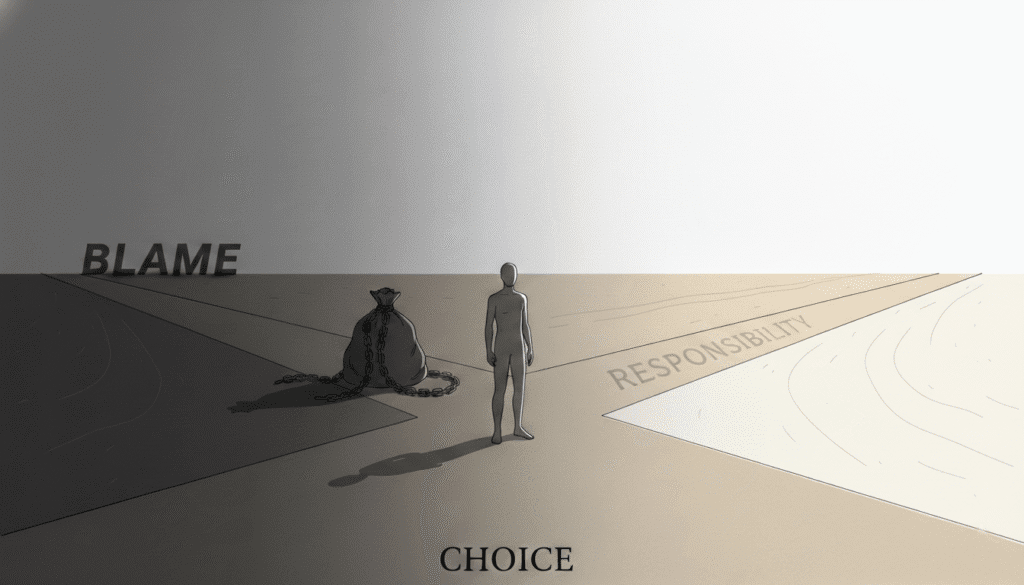
Blame says: “This shouldn’t have happened. They had no right.”
And you keep holding the bag while you argue.
Responsibility without blame notices something simpler.
You’re holding something heavy.
You can put it down.
You can hand it back.
You can refuse to carry it further.
What This Looks Like
Someone speaks sharply to you.
Responsibility without blame does not deny what happened.
It does not excuse their behaviour.
It simply notices what is happening inside you right now.
Tightness in the chest. Thoughts moving fast. The urge to react.
From that noticing, clarity appears.
You might set a boundary: “I’m not continuing this conversation while you’re speaking that way.”
You might disengage: “I need some space.”
You might simply breathe and let the moment pass.
None of these responses require blame.
They come from recognizing what you’re holding and choosing whether to keep holding it.
Why Responsibility Is Often Confused With Endurance
Many people hear “responsibility” and think it means tolerating everything.
Absorbing every slight.
Carrying every discomfort.
Never saying no.
This is not responsibility.
This is endurance disguised as maturity.
Responsibility without blame recognizes limits.
It allows you to say: “This doesn’t work for me.”
It permits boundaries without inner punishment.
The difference is simple.
Endurance carries the bag and resents it.
Responsibility puts the bag down.
Where Your Influence Actually Exists
You cannot control people.
You cannot rewrite the past.
You cannot guarantee outcomes.
But you can notice how you are relating to what is happening.
You can respond consciously instead of reacting automatically.
This is where responsibility without blame restores power — not by fixing life, but by restoring clarity.
How This Changes Life Over Time
When responsibility without blame becomes clear, changes are subtle but consistent.
You argue less internally.
You find solutions faster.
You recover faster from emotional disturbance.
You stop carrying situations long after they are finished.
Life still brings challenges, but they no longer define you.
You are no longer fighting life. You are responding to it.
Life becomes lighter when you stop arguing with what has already happened.
Related Clarity
- The Mechanical Mind: Why Life Feels Repetitive
- Time Is the Real Trap: How Yesterday and Tomorrow Create Suffering
- Why Happy People Do Less
Take-Home Clarity: What This Article Really Points To
If this article could leave you with a few simple reminders, let them be these:
- Responsibility is not about fault; it is about the ability to respond now.
- Blame keeps attention stuck in the past, while responsibility moves life forward.
- You do not need to carry situations simply because they appeared in your life.
- Clear responses and boundaries can exist without guilt or inner punishment.
- Power returns when attention shifts from “Whose fault?” to “What now?”
- Responsibility without blame allows action without resentment.
- You cannot control events, but you can respond consciously.
- Life becomes lighter when situations are handled instead of mentally replayed.
You don’t need to carry every burden handed to you.
You only need to notice what you are holding and choose consciously.
And in that choice, clarity quietly replaces struggle.
FAQs
What does responsibility without blame mean?
It means responding to experience without accusing yourself or others.
Does responsibility mean accepting everything?
No. Clear boundaries can exist without inner blame.
Why does blame feel automatic?
Because blame creates certainty and avoids discomfort.
Is responsibility about control?
No. It is about clarity in response, not control over outcomes.
Can responsibility exist without guilt?
Yes. Responsibility without blame removes guilt while preserving clarity.
What changes first when responsibility becomes clear?
Reaction slows and conscious choice becomes visible.
Is this about becoming passive?
No. It allows clearer, more effective action.